


Category
|
Order Code |
Product Name |
|
L-01-11-M17 |
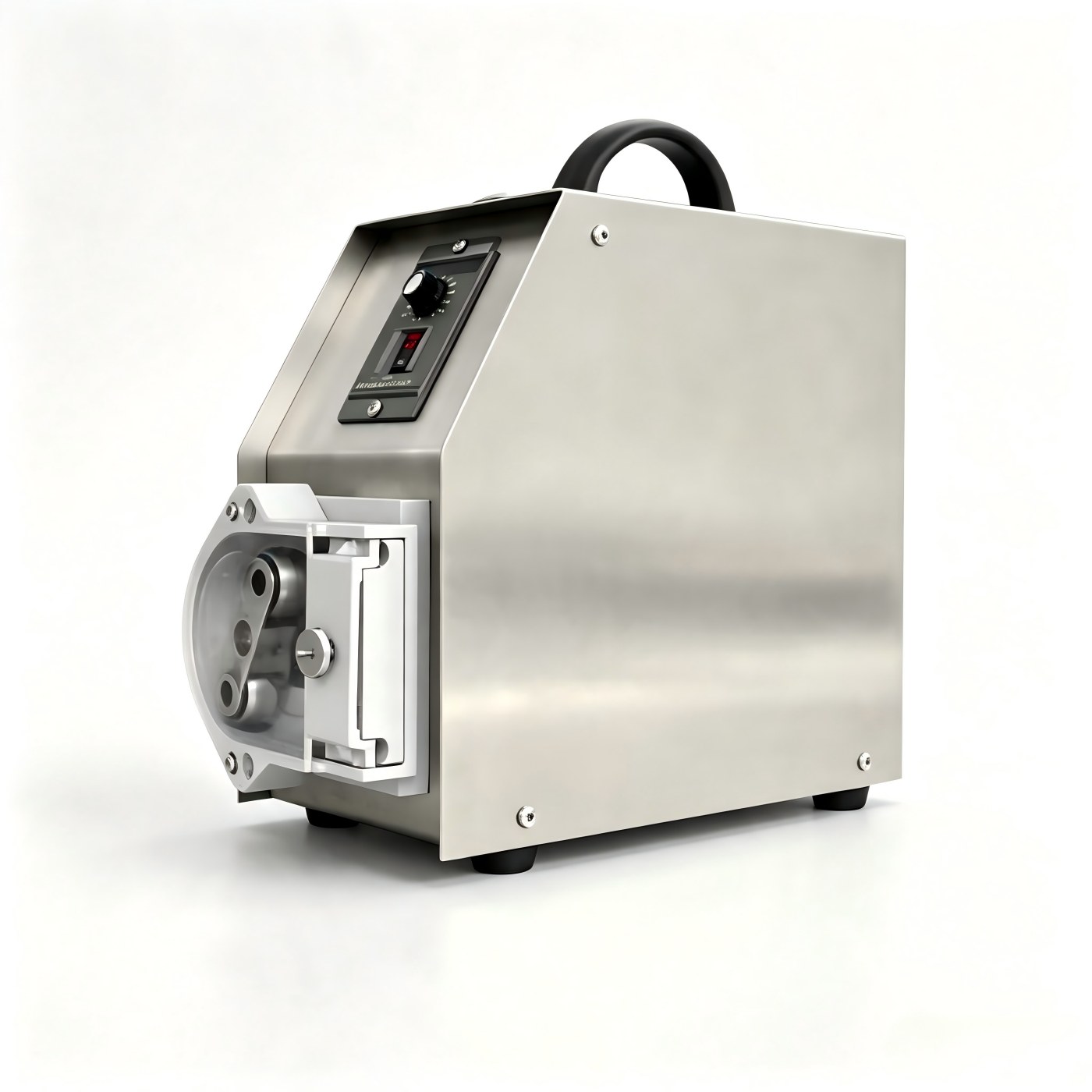
Variable Peristaltic Pump for Mining Laboratory Sample Transfer and Reagent Dosing |

The Variable Peristaltic Pump is a precision positive-displacement liquid transfer device designed for laboratory and small-scale mineral processing environments. Based on a non-contact transmission principle, the conveyed medium only flows through the hose without direct contact with the pump body, reducing the risk of liquid contamination and equipment corrosion during operation.
Equipped with frequency conversion stepless speed regulation, this laboratory pump provides stable and continuously adjustable flow output for different liquid transportation requirements. It is suitable for conveying ore pulp, flotation reagents, chemical solutions and viscous fluids in metallurgical, geological, chemical and building material laboratories as well as pilot mineral processing plants.
With two configurable specifications for low-flow precision dosing and high-volume medium transfer, the equipment delivers repeatable liquid conveying performance for mineral sample preparation, flotation testing and metallurgical experimental workflows.
The Variable Peristaltic Pump supports important mining laboratory workflows including mineral sample preparation, metallurgical testing and hydrometallurgical experimental research.
During mineral sample preparation, the pump provides stable and continuous transportation of ore slurry and viscous mineral samples. Consistent flow delivery helps maintain uniform sample feeding conditions and supports standardized pretreatment procedures before mineral analysis.
In metallurgical testing and flotation experiments, the pump enables adjustable delivery of flotation reagents and chemical solutions. The stepless speed regulation system allows laboratory technicians to control liquid feeding speed according to experimental requirements, improving test condition consistency and repeatability.
For hydrometallurgy laboratory applications, the equipment supports medium circulation and reagent delivery during leaching, purification and precipitation experiments. The isolated hose structure helps prevent cross-contamination between different chemical media and supports reliable experimental data collection.
The conveyed medium remains inside the hose and does not contact the pump body, improving compatibility with corrosive reagents, ore pulp and chemical solutions while reducing contamination risks.
Frequency conversion stepless speed regulation provides smooth flow adjustment, allowing flexible matching with different liquid viscosities and laboratory testing requirements.
Two working specifications are available. The standard model is suitable for low-flow precision dosing and routine laboratory tests, while the high-flow model supports larger-volume liquid transfer and pilot-scale mineral processing applications.
The matched gear motor and gearbox system maintain continuous and stable operation, reducing flow fluctuation during extended laboratory testing cycles.
Multiple hose diameter options improve application adaptability for different liquid conditions, from low-viscosity reagents to high-viscosity ore pulp.
The compact structure and practical installation design allow flexible arrangement in laboratory environments and simplify daily maintenance procedures.
| Parameter Item | Standard Model | Optional High-Flow Model |
|---|---|---|
| Rotating Speed | 12–180 r/min | 17–120 r/min |
| Flow Rate | 0.1–1.6 L/min | 2.2–15.5 L/min |
| Delivery Lift | 2–4 m | 15 m |
| Hose Inner Diameter | Φ6 mm / Φ9 mm | Φ19×4 mm |
| Motor & Gearbox Model | 61K140RGV-CF, 140W | 20YCJT-250W, 1200 r/min |
| Overall Dimensions | 300×146×130 mm | 385×249×246 mm |
| Weight | 15 kg | 40 kg |
Two distinct working specifications are available to match different laboratory and pilot-scale processing requirements. The standard low-flow model provides compact size and precise flow adjustment for flotation reagent dosing and small-volume sample transportation.
The upgraded high-flow model uses larger hose diameter, higher power motor and higher delivery lift, supporting high-volume pulp circulation and medium transfer during pilot beneficiation experiments. Users can select suitable configuration according to flow volume, medium viscosity and working lift requirements.
FKN PANDA Variable Peristaltic Pump provides reliable testing accuracy through stable flow output and adjustable speed control. The frequency conversion regulation system reduces manual feeding variation and maintains consistent liquid delivery conditions for mineral analysis and metallurgical testing.
The equipment ensures operational reliability with a professionally matched gear motor and gearbox system. The non-contact hose transmission design reduces corrosion impact and helps maintain stable performance during repeated laboratory operation.
The pump improves laboratory efficiency by providing continuous adjustable liquid delivery. Flexible operating parameters reduce manual dosing work and simplify sample preparation, flotation testing and experimental procedures.
Designed for mining and metallurgical workflows, the equipment integrates with mineral slurry transportation, reagent dosing, flotation testing and hydrometallurgical experimental processes, supporting laboratory-to-pilot-scale testing requirements.
The dual-specification design provides cost effectiveness by allowing users to select suitable equipment according to actual flow requirements. Durable components and reduced maintenance requirements help lower long-term operating costs for laboratories, research institutions and pilot processing facilities.
Q1. How to select a variable speed hose pump for slurry transfer in mineral processing laboratories?
Selecting a variable speed hose pump for a mining laboratory requires evaluation of slurry characteristics, flow requirements, chemical compatibility, and testing objectives. Key considerations include slurry concentration, particle characteristics, viscosity, required flow stability, and whether the pump will be used for batch testing or continuous laboratory circuits. In mineral processing workflows, the pump should support reliable transfer between sample preparation, flotation, leaching, and other metallurgical evaluation stages. Proper selection helps maintain consistent experimental conditions and improves the repeatability of laboratory test results.
Q2. What factors should be considered when choosing a variable hose pump for abrasive slurry applications?
For abrasive slurry applications, laboratory operators should consider hose material compatibility, slurry particle characteristics, operating frequency, and expected service conditions. Mining samples often contain hard mineral particles that can accelerate wear during continuous transfer operations. A suitable variable hose pump should provide stable slurry handling while minimizing contamination risks and reducing interruptions caused by component replacement. Evaluating the relationship between slurry properties and pump configuration helps laboratories maintain reliable operation during mineral processing experiments and metallurgical testing programs.
Q3. How does variable speed control improve process flexibility in hydrometallurgical testing circuits?
Variable speed control allows laboratory engineers to adjust slurry or reagent transfer rates according to different experimental requirements. In hydrometallurgical testing, flow conditions can influence residence time, mixing behavior, and reaction consistency during leaching or solution treatment studies. A variable hose pump provides greater control when researchers evaluate different process conditions during metallurgical experiments. This flexibility supports laboratory optimization, equipment comparison, and process evaluation from initial sample testing through more advanced development studies.
Q4. Can a variable hose pump handle corrosive leaching solutions without contamination?
A variable hose pump can be considered for corrosive leaching applications when the wetted materials, hose composition, and operating conditions are compatible with the process solution. Since the pumped fluid contacts mainly the hose rather than complex internal mechanical components, contamination risk can be reduced in certain laboratory applications. Before selection, laboratories should evaluate chemical compatibility with acids, alkalis, solvents, or other reagents used in metallurgical testing. Proper material selection is important for maintaining accurate analytical results and stable long-term operation.
Q5. How to ensure testing repeatability when using variable hose pumps for slurry transfer?
Testing repeatability depends on maintaining consistent slurry flow conditions throughout each experimental cycle. Laboratories should control key factors such as pump speed setting, slurry properties, hose condition, and operating procedures. In mineral processing research, stable transfer conditions help ensure that flotation tests, leaching studies, and other metallurgical evaluations are based on comparable parameters. Regular verification of flow performance and proper maintenance practices can reduce experimental variation and improve confidence when comparing different ore samples or process conditions.
Q6. What maintenance requirements are typical for variable hose pumps in continuous mining laboratory operation?
Maintenance requirements for variable hose pumps generally focus on monitoring hose wear, checking drive components, and confirming stable flow performance during operation. In continuous mining laboratory applications, abrasive slurries and chemical solutions may affect hose service life over extended testing periods. Routine inspection helps identify wear-related flow changes before they influence experimental results. Establishing a maintenance schedule based on operating conditions supports continuous laboratory operation and reduces unexpected interruptions during mineral processing and metallurgical research programs.
Q7. How does hose wear affect flow rate accuracy in variable speed hose pumps?
Hose wear can influence pumping performance by changing the internal flow characteristics and reducing consistency over extended operation. In laboratory mineral processing applications, variations in slurry transfer rate may affect test conditions and the interpretation of experimental results. Monitoring hose condition and replacing worn components when necessary helps maintain stable flow delivery. This is particularly important for hydrometallurgy and flotation studies where controlled material transfer is required to evaluate process behavior accurately.
Q8. How to select variable hose pump capacity for batch versus continuous laboratory experiments?
Pump capacity selection should be based on the laboratory process design, required transfer volume, slurry characteristics, and operating mode. Batch experiments may require flexible flow adjustment for different test stages, while continuous circuits require stable operation over longer periods. For mineral processing laboratories, the selected pump should match the scale of sample handling and the requirements of the testing workflow. Considering future laboratory expansion or additional testing applications can also help ensure the equipment remains suitable for evolving research needs.
Q9. Can variable hose pumps be integrated with level sensors for automated tank transfer in mining labs?
Variable hose pumps can be incorporated into automated laboratory systems when compatible control interfaces and monitoring devices are available. Integration with level sensors may support automatic material transfer between tanks during continuous mineral processing or hydrometallurgical experiments. Such configurations can help laboratories improve process consistency, reduce manual operation requirements, and maintain controlled experimental conditions. When planning automation, engineers should evaluate communication requirements, control methods, and the overall workflow of the laboratory testing system.
Q10. How to scale variable hose pump parameters from laboratory to pilot plant mineral processing testing?
Scaling pump parameters from laboratory testing to pilot plant applications requires careful evaluation of flow behavior, slurry characteristics, process conditions, and equipment configuration. Laboratory results provide valuable information for understanding material handling requirements, but scale-up decisions should consider differences in operating volume and process environment. Variable hose pumps used during laboratory studies can help establish baseline transfer conditions for further engineering evaluation. Consistent documentation of test parameters supports smoother transition from laboratory experiments to larger-scale mineral processing studies.
Contact Information
E-mail:
Tel:
Address : Room 2512, Unit 1, Huaqiao Square, No.1, Daqiao North Road, Jiangbei New District, Nanjing, China
Veterinary Equipment
Medical Equipment

 There is currently no content to display


