


Category
|
Order Code |
Product Name |
|
A-06-05-M01 |
Veterinary Pulse Oximeter | SpO₂, PR & Waveform Monitoring |

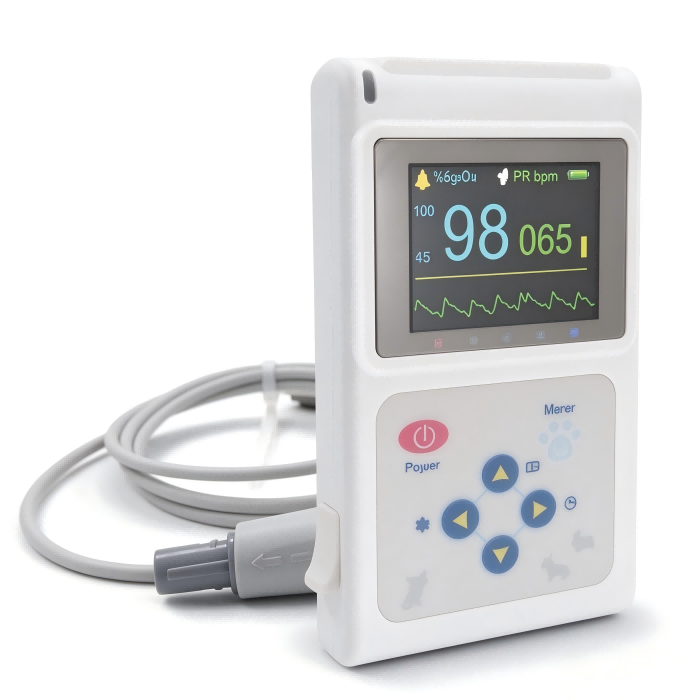
The FKNMED Veterinary Pulse Oximeter is a non-invasive monitoring device designed for veterinary hospitals, clinics, and animal care facilities. It displays SpO₂ values, pulse rate (PR), a PR bar graph, and pulse waveform to support continuous observation of oxygenation and pulse activity during anaesthesia, surgery, recovery, and critical care.
The device supports connection to an external SpO₂ probe, real-time data transmission, and internal data storage with computer upload capability. Additional functions include adjustable screen brightness, a PR sound prompt, and audible alarms for measurement data overrange and low battery. These features support routine physiological monitoring and documentation in professional veterinary environments.
Designed for continuous SpO₂ and PR observation during general anaesthesia and surgical procedures. The waveform display provides an additional visual reference during intraoperative monitoring.
Suitable for monitoring animals during post-anaesthetic recovery and critical care observation, supporting continued assessment of oxygen saturation and pulse rate.
Can be used during sedated radiographic and advanced imaging procedures where continuous non-invasive physiological monitoring is required.
Suitable for monitoring during sedated dental treatment, ophthalmic examinations, and related procedures requiring observation of SpO₂ and PR.
Supports baseline oxygenation and pulse rate assessment during veterinary examinations and clinical evaluations in animal hospitals and pet clinics.
Can support physiological monitoring during field anaesthesia and veterinary interventions involving animals that require non-invasive SpO₂ and pulse rate observation.
Suitable for physiological data collection during research protocols, toxicology studies, and experimental procedures requiring documented oxygenation and pulse rate information.
Can be incorporated into professional animal healthcare workflows where pulse oximetry monitoring is required during clinical handling or procedures.
The device displays SpO₂ values and PR values, together with a PR bar graph. These parameters provide clinicians with information for monitoring oxygen saturation and pulse rate during veterinary procedures.
The pulse waveform provides a visual representation of the measured pulse signal, complementing the numerical SpO₂ and PR readings during continuous monitoring.
An external SpO₂ probe can be connected to the unit. This configuration supports probe-based monitoring in veterinary clinical environments. Specific probe models and animal-size compatibility should be confirmed according to the selected configuration.
The device supports real-time data transmission and internal data storage. Stored monitoring data can be uploaded to a computer for review and documentation, supporting veterinary clinical records and research workflows.
Screen brightness can be adjusted to suit different clinical lighting conditions. The PR sound prompt provides an audible reference during monitoring.
Audible prompts are provided for measurement data overrange and low battery conditions, helping users identify these operating conditions during monitoring.
The product is specified as CE certified, supporting procurement evaluation by international veterinary equipment distributors and institutional buyers.
| Item | Specification |
|---|---|
| Product Type | Veterinary Pulse Oximeter |
| SpO₂ Display | Yes |
| PR Display | PR value and bar graph |
| Waveform Display | Pulse waveform |
| Review Function | Yes |
| External Probe | External SpO₂ probe can be connected |
| Data Transmission | Real-time |
| Data Storage | Stored data can be uploaded to a computer |
| Screen Brightness | Adjustable |
| Audio Prompt | PR sound prompt |
| Alarm Function | Audible prompts for measurement data overrange and low battery |
| Certification | CE certified |
FKNMED supplies veterinary monitoring equipment for animal hospitals, veterinary clinics, farms, laboratories, and international distribution channels. This pulse oximeter combines SpO₂ and PR display, pulse waveform monitoring, external probe connection, data storage, and real-time transmission in one monitoring unit.
For distributors, importers, and institutional procurement teams, the defined monitoring functions and CE certification provide key product information for supplier evaluation and purchasing discussions. Computer-uploadable records also support veterinary facilities that require monitoring data for clinical documentation or research workflows.
FKNMED supports international B2B procurement with product supply for veterinary equipment distributors and institutional buyers. Contact our team for product specifications, probe configuration details, and quotation information.
Q1. What factors should veterinary clinics consider when selecting a pulse oximeter?
Selection should be based on the intended monitoring environment, patient species, probe compatibility and clinical workflow. Small animal clinics may require SpO₂ and pulse rate monitoring during anaesthesia, procedures and post-operative recovery, while referral hospitals may need equipment that supports continuous observation and patient record management. This veterinary pulse oximeter provides SpO₂ and PR monitoring, waveform display, data storage and real-time data transmission. Buyers should also verify measurement specifications, supported probe types, animal size compatibility, data interface requirements and alarm functions before procurement. These details help determine whether the equipment is appropriate for routine clinical use or more demanding monitoring applications.
Q2. Can this veterinary pulse oximeter be used for canine and feline anaesthesia monitoring?
SpO₂ and pulse rate monitoring are relevant to canine and feline anaesthesia workflows because they provide information about peripheral oxygen saturation and pulse activity during procedures. The waveform display can help veterinary personnel assess the quality and continuity of the detected pulse signal, while real-time transmission supports observation of monitoring data. Probe selection and placement must be appropriate for the patient's anatomy and size. Movement, poor peripheral perfusion and unsuitable probe positioning may affect readings. This device can be considered for anaesthesia monitoring, but its suitability for a particular animal should be confirmed against the manufacturer's probe compatibility and measurement specifications.
Q3. Which veterinary procedures benefit from continuous SpO₂ and PR monitoring?
Continuous SpO₂ and PR monitoring can support veterinary procedures in which changes in oxygenation and pulse rate need to be observed over time. Common workflow considerations include general anaesthesia, selected clinical procedures, post-operative recovery and monitoring of patients requiring closer observation. In referral hospitals, recorded and transmitted data may also support communication between clinical personnel during patient care. A pulse oximeter provides physiological monitoring information, but it does not replace clinical examination or other required monitoring methods. Veterinary teams should interpret readings in the context of the patient's condition, procedure, perfusion status and the overall anaesthesia or treatment protocol.
Q4. How does pulse waveform display improve veterinary SpO₂ monitoring?
The pulse waveform provides a visual representation of the detected pulsatile signal and adds context to the numerical SpO₂ and PR readings. Veterinary personnel can observe whether a waveform is present and reasonably consistent while assessing the displayed values. This is particularly useful during anaesthesia and recovery, when patient movement or changes in peripheral perfusion may affect signal quality. A waveform should not be interpreted as independent proof of adequate oxygenation or as a substitute for clinical assessment. Staff should evaluate it alongside the numerical readings, patient condition and other monitoring information, and investigate unexpected changes before making clinical decisions.
Q5. How should veterinary staff select and position an SpO₂ probe for reliable measurements?
Probe selection should account for the animal's species, body size, anatomical site and the probe types supported by the monitor. The sensor should be positioned according to the manufacturer's instructions, with appropriate alignment and stable contact at the measurement site. Excessive pressure, movement, ambient interference, poor peripheral perfusion and unsuitable placement can contribute to unstable or unreliable readings. During monitoring, staff should check the waveform and PR display rather than relying only on a single SpO₂ value. The supplied product information does not specify probe models or supported anatomical sites, so these compatibility details should be confirmed before ordering.
Q6. What factors can affect veterinary pulse oximeter measurement reliability?
Measurement reliability can be affected by patient movement, probe displacement, poor peripheral perfusion, inappropriate sensor selection and interference at the measurement site. Differences in animal anatomy and body size also make correct probe compatibility important in veterinary applications. During anaesthesia or recovery, veterinary personnel should secure the probe appropriately, observe the waveform and PR bar graph, and check whether displayed values remain consistent with the patient's clinical condition. If readings become unstable or unexpected, staff should assess probe placement and signal quality before interpreting the result. Pulse oximetry should be used as part of an integrated monitoring process rather than as the sole basis for clinical evaluation.
Q7. How do real-time data transmission and internal data storage support veterinary monitoring workflows?
Real-time data transmission can make monitoring information available to compatible connected systems or designated observation points, depending on the device interface and configuration. This may support clinical coordination when personnel need to observe patient data during procedures or recovery. Internal data storage provides a way to retain monitoring records for later review, patient follow-up and clinical documentation. For hospitals managing multiple cases, these functions may help organize monitoring information across different stages of care. Before procurement, buyers should confirm supported communication interfaces, data formats, storage capacity, export options and compatibility with their existing veterinary information systems.
Q8. Can this veterinary pulse oximeter be used for post-operative recovery and critical care monitoring?
SpO₂ and PR monitoring can support observation during post-operative recovery and selected critical care workflows where oxygen saturation and pulse rate are relevant to patient assessment. Waveform display helps staff review the detected pulse signal, while data storage and real-time transmission can support documentation and ongoing observation. Monitoring requirements vary according to species, patient condition and clinical procedure. A pulse oximeter does not measure every parameter required for critical care, and it should be integrated with other appropriate examination and monitoring methods. Veterinary teams should follow their clinical protocols and confirm the device's measurement and alarm capabilities before using it in higher-acuity settings.
Q9. What maintenance and cleaning are required for a veterinary pulse oximeter?
Routine maintenance should include inspection of the monitor housing, display, probe, sensor surfaces and connecting cables. Clean and disinfect patient-contact components using methods and products approved by the manufacturer, taking care not to damage optical elements or electrical connections. Check cables and connectors for wear, loose connections or visible damage, and confirm that the monitor operates normally before clinical use. Probe performance should also be checked according to the manufacturer's maintenance recommendations. For clinics with frequent anaesthesia and recovery cases, a documented inspection and cleaning schedule can help maintain equipment availability and reduce avoidable interruptions in routine monitoring workflows.
Q10. What specifications should distributors and veterinary hospitals compare before purchasing a pulse oximeter?
Procurement teams should evaluate the device's supported SpO₂ and PR monitoring functions, waveform display, PR bar graph, internal data storage and real-time transmission capability. They should also request the measurement range, accuracy specifications, update interval, alarm functions, supported probe types, compatible animal sizes, battery or power requirements and communication interfaces. These technical details are not provided in the product description and should be confirmed before purchase. Distributors should additionally review probe availability, replacement-part supply, user documentation, cleaning requirements and after-sales support. A structured comparison helps buyers assess suitability for small animal clinics, referral hospitals, veterinary laboratories and other intended monitoring environments.
{ "@context": "https://schema.org", "@graph": [ { "@type": "Organization", "@id": "https://www.fknmed.com/veterinary-equipment/#organization", "name": "Nanjing FKN Medical Tech Co., Ltd", "url": "https://www.fknmed.com/Veterinary-equipment/", "contactPoint": { "@type": "ContactPoint", "telephone": "+86 13770648803", "email": "liu-liming@fknmed.com", "contactType": "sales", "availableLanguage": "English" } }, { "@type": "Product", "@id": "https://www.fknmed.com/veterinary-pulse-oximeter/Veterinary-Pulse-Oximeter.html#product", "name": "Veterinary Pulse Oximeter", "description": "A non-invasive veterinary monitoring device displaying SpO₂, pulse rate, a PR bar graph, and pulse waveform. It supports external probe connection, real-time data transmission, internal data storage with computer upload, adjustable screen brightness, audible prompts, and CE certification.", "image": "https://www.fknmed.com/static/upload/image/20261123/1795393855198410.png", "category": "Veterinary Patient Monitoring Equipment", "brand": { "@type": "Brand", "name": "FKNMED" }, "manufacturer": { "@id": "https://www.fknmed.com/veterinary-equipment/#organization" }, "offers": { "@type": "Offer", "url": "https://www.fknmed.com/veterinary-pulse-oximeter/Veterinary-Pulse-Oximeter.html", "availability": "https://schema.org/InStock" } } ] }Contact Information
E-mail:
Tel:
Address : Room 2512, Unit 1, Huaqiao Square, No.1, Daqiao North Road, Jiangbei New District, Nanjing, China
Veterinary Equipment
Medical Equipment

 There is currently no content to display


