


Category
|
Order Code |
Product Name |
|
A-04-16-M13 |
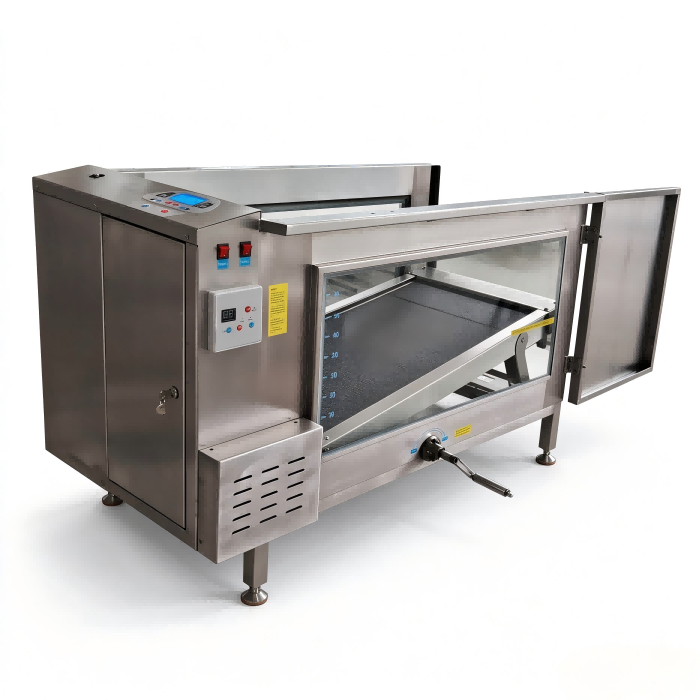
Large Dog Underwater Treadmill | Veterinary Hydrotherapy Rehabilitation Equipment |

The FKNMED Large Dog Underwater Treadmill is a veterinary hydrotherapy rehabilitation system designed for large-breed dogs and heavy patients. It features a 470 × 1600 mm running surface, an adjustable speed range of 0.8–12 km/h, and manual incline adjustment for controlled exercise sessions.
Powered by a 3 HP motor and supporting a maximum user weight of 110 kg, the treadmill is suitable for veterinary hospitals, animal rehabilitation centres, referral clinics, and professional physiotherapy facilities. Its specifications support structured underwater walking and conditioning programs, including rehabilitation planning following surgery or musculoskeletal injuries.
Designed for structured underwater walking and rehabilitation exercise for large dogs. It can be incorporated into veterinary rehabilitation programs following orthopaedic surgery, cruciate ligament repair, fracture recovery, intervertebral disc disease management, and soft-tissue injury recovery, according to veterinary assessment and treatment protocols.
Suitable for veterinary practices incorporating controlled mobility exercises into post-operative recovery plans. Adjustable running speed and manual incline settings allow veterinary professionals to select exercise parameters according to individual patient requirements.
The treadmill provides a controlled exercise environment for observing gait, weight-bearing tolerance, and mobility during rehabilitation sessions. Its adjustable operating parameters can support progress documentation alongside other veterinary examination findings.
Suitable for professional animal hospitals, veterinary clinics, referral centres, and dedicated physiotherapy departments handling large-breed dogs and heavier patients.
The 110 kg maximum user weight capacity and 0.8–12 km/h speed range make the equipment suitable for structured conditioning and mobility maintenance programs for working, service, and performance dogs.
Can be incorporated into research and rehabilitation assessment workflows where controlled exercise speed and incline settings are required for structured locomotion observation.
The 0.8–12 km/h speed range and manual incline adjustment provide configurable exercise settings for different rehabilitation and conditioning sessions. These parameters help veterinary professionals maintain consistent exercise conditions and document changes between sessions.
Equipped with a 3 HP motor and a maximum user weight capacity of 110 kg, the treadmill is configured for large-breed dogs and heavier veterinary rehabilitation patients. The 470 × 1600 mm running surface provides the specified exercise area for patient movement.
The 470 × 1600 mm running surface is designed for large-dog applications. Its dimensions provide a defined walking area for controlled hydrotherapy and rehabilitation sessions.
Manual incline adjustment allows the exercise angle to be changed according to the rehabilitation program. This configuration provides a straightforward adjustment method without requiring a motorized incline system.
With product dimensions of 1890 × 630 × 1370 mm and a gross weight of 203 kg, the unit is intended for planned installation in veterinary hydrotherapy rooms, rehabilitation suites, and animal physiotherapy facilities. Buyers should confirm available room space and site access before ordering.
The specified product dimensions and packaging dimensions support freight planning by veterinary equipment distributors, importers, and institutional buyers. The equipment is suitable for single-unit procurement as well as evaluation for larger veterinary rehabilitation facility requirements.
| Item | Specification |
|---|---|
| Product Name | Large Dog Underwater Treadmill |
| Incline Adjustment | Manual incline adjustment |
| Running Surface | 470 × 1600 mm |
| Speed Range | 0.8–12 km/h |
| Running Surface Thickness | 1.6 mm |
| Motor | 3 HP |
| Maximum User Weight | 110 kg |
| Internal Dimensions | 167 × 53–77 cm (height measured to the base, excluding the running belt) |
| Gross Weight (G.W.) | 203 kg |
| Net Weight (N.W.) | 175 kg |
| Packaging Dimensions | 1970 × 800 × 1170 mm |
| Product Dimensions | 1890 × 630 × 1370 mm |
FKNMED supplies veterinary equipment for animal hospitals, clinics, rehabilitation facilities, and international veterinary equipment distributors. The Large Dog Underwater Treadmill combines a large running surface, a 3 HP motor, adjustable running speed, and manual incline adjustment in a configuration intended for professional canine hydrotherapy and rehabilitation applications.
For importers and distributors, clearly specified operating parameters, product dimensions, and packaging dimensions provide essential information for product evaluation, procurement planning, and international freight arrangements. The equipment can be considered for veterinary rehabilitation facilities seeking an alternative to higher-priced imported hydrotherapy systems, subject to technical and commercial evaluation.
Veterinary hospitals and rehabilitation professionals can assess the treadmill according to patient weight requirements, available installation space, rehabilitation workflow, and intended exercise protocols. Contact FKNMED for product information and B2B supply enquiries.
Q1. How should veterinary rehabilitation centers select an underwater treadmill for large dogs?
Veterinary rehabilitation centers should evaluate treadmill dimensions, motor capacity, load limits, incline adjustment, and compatibility with their intended clinical cases. For large dogs, the internal dimensions and running surface are particularly important because the animal needs sufficient space to walk with a natural gait. This model features an internal dimension of 167 × 53–77 cm, a 470 × 1600 mm running surface, and a 3 HP motor. Its manual incline adjustment also allows rehabilitation professionals to vary the exercise configuration. Before procurement, facilities should compare these specifications with the size and weight of their target patients, available installation space, expected treatment volume, and daily operating requirements.
Q2. Can this underwater treadmill be used for post-operative canine rehabilitation?
An underwater treadmill may be incorporated into a post-operative canine rehabilitation program when the attending veterinarian or rehabilitation professional considers the animal clinically suitable for controlled exercise. Water-based treadmill activity can support a structured return to movement while allowing the rehabilitation team to adjust exercise conditions according to the patient's recovery stage. Before each session, the team should assess the surgical site, mobility, pain response, and any restrictions specified by the treating veterinarian. Treadmill speed, water level, session duration, and incline should be selected according to the individual rehabilitation plan rather than a fixed setting. This model provides a dedicated running surface and manual incline adjustment for supervised canine rehabilitation workflows.
Q3. How does incline adjustment support large dog rehabilitation?
Incline adjustment allows rehabilitation professionals to vary the treadmill exercise configuration according to the dog's mobility, physical condition, and rehabilitation objectives. A level walking surface may be appropriate for some controlled movement sessions, while an adjusted incline can introduce a different exercise demand for suitable patients. This flexibility is relevant to rehabilitation programs involving muscle conditioning, gait training, and gradual activity progression. The incline should not be increased automatically or treated as a substitute for an individualized treatment plan. Veterinary professionals should consider the dog's orthopedic or neurological condition, movement quality, fatigue, and response during exercise. Manual incline adjustment gives the clinical team an additional parameter to manage within supervised rehabilitation sessions.
Q4. Why is a 3 HP motor important for a large dog underwater treadmill?
Motor capacity is an important specification when evaluating an underwater treadmill intended for large dog rehabilitation. The 3 HP motor rating provides procurement teams with a defined reference point for comparing equipment configurations and assessing whether a model matches the expected operating requirements of their facility. Motor capacity should be considered alongside the treadmill's running surface, internal dimensions, load limit, and intended usage frequency. It should not be interpreted independently as proof of suitability for every large dog or every rehabilitation protocol. Veterinary centers should review the complete equipment specifications and confirm the permitted operating conditions with the supplier before purchase, particularly when planning frequent clinical use or introducing the equipment into an expanding rehabilitation service.
Q5. How do the 470 × 1600 mm running surface and 167 × 53–77 cm internal dimensions support large dog therapy?
Running surface dimensions and internal chamber space are important when selecting an underwater treadmill for large dogs. This model has a 470 × 1600 mm running surface and an internal dimension of 167 × 53–77 cm. These measurements provide procurement teams with concrete information for evaluating the available exercise space against the body size and gait requirements of their intended patients. A suitable fit should allow the dog to walk without unnecessary restriction while remaining appropriately positioned during supervised sessions. Veterinary professionals should assess the animal's body length, stance, turning and entry requirements, and movement pattern before use. The stated dimensions should be checked against the actual patient population rather than assumed to accommodate every large breed.
Q6. How should veterinarians select treadmill speed for post-surgical canine recovery?
Treadmill speed should be selected according to the dog's clinical condition, surgical recovery stage, gait quality, and tolerance for controlled exercise. Post-operative patients may have different mobility restrictions and exercise requirements, so a single speed setting is not appropriate for every case. The treating veterinarian or rehabilitation professional should establish the permitted activity level and monitor the dog's movement throughout each session. If the animal shows discomfort, fatigue, altered gait, or difficulty maintaining a stable walking pattern, the session should be reassessed. Speed selection should also be considered together with water level and incline, since these parameters influence the exercise environment. A documented, patient-specific approach helps maintain consistency across repeated rehabilitation sessions.
Q7. Can an underwater treadmill support rehabilitation for canine arthritis and chronic orthopedic conditions?
Underwater treadmill exercise may be considered as part of a veterinarian-supervised rehabilitation plan for dogs with selected chronic orthopedic conditions, including arthritis. The suitability of water-based exercise depends on the dog's diagnosis, mobility, pain level, general health, and response to activity. Rehabilitation professionals should define the exercise objectives and determine appropriate water and treadmill settings for each patient. The equipment can provide a controlled environment for walking exercises, while its manual incline adjustment offers an additional parameter for suitable programs. However, the treadmill does not replace clinical assessment, medication, or other prescribed interventions. Veterinary centers should establish patient selection and monitoring procedures before incorporating underwater treadmill sessions into routine orthopedic rehabilitation services.
Q8. What factors affect safety during large dog underwater treadmill therapy?
Safe operation depends on patient suitability, equipment condition, appropriate setup, and continuous supervision. Before a session, veterinary staff should assess the dog's mobility, behavior, physical condition, and ability to enter and remain in the treadmill chamber safely. The running surface should be checked for cleanliness and signs of damage, while water level, speed, and incline should be selected according to the individual treatment plan. Staff should monitor gait, balance, fatigue, and signs of distress throughout the session. The stated 110 kg user weight limit should also be reviewed as part of the equipment's operating specifications, with its exact application confirmed before procurement and use. Facilities should follow the manufacturer's operating and safety instructions.
Q9. What maintenance and cleaning are required for a large dog underwater treadmill?
Routine maintenance helps veterinary facilities manage equipment condition and reduce avoidable interruptions to rehabilitation services. After use, staff should follow the manufacturer's instructions for draining, cleaning, and disinfecting the water-contact areas, chamber, and running surface. Cleaning procedures should use products compatible with the equipment materials and should prevent chemical residues from remaining where animals will make contact. The running surface should be inspected for wear, damage, or changes that could affect traction. Facilities should also establish a schedule for checking the motor, mechanical components, water-handling system, and incline adjustment mechanism in accordance with the manufacturer's guidance. Recording cleaning and maintenance activities supports consistent hygiene management and long-term equipment oversight.
Q10. What specifications should distributors compare when sourcing underwater treadmills for veterinary rehabilitation centers?
Distributors should compare the specifications that directly affect patient suitability, installation, daily operation, and after-sales support. Relevant factors include motor capacity, internal chamber dimensions, running surface size and thickness, load limit, incline adjustment, cleaning requirements, and maintenance access. This model specifies a 3 HP motor, a 470 × 1600 mm running surface, a 1.6 mm running surface thickness, internal dimensions of 167 × 53–77 cm, and a 110 kg user weight limit. These details provide a basis for technical comparison, but distributors should confirm the meaning and operating conditions of each specification with the supplier. Matching the equipment to the target clinic's patient profile and service requirements is essential for responsible product selection.
{ "@context": "https://schema.org", "@graph": [ { "@type": "Organization", "@id": "https://www.fknmed.com/veterinary-equipment/#organization", "name": "Nanjing FKN Medical Tech Co., Ltd", "url": "https://www.fknmed.com/Veterinary-equipment/", "contactPoint": { "@type": "ContactPoint", "telephone": "+86 13770648803", "email": "liu-liming@fknmed.com", "availableLanguage": "English", "areaServed": "International veterinary market" } }, { "@type": "Product", "@id": "https://www.fknmed.com/pet-treadmill/large-dog-underwater-treadmill-incline-adjustment.html#product", "name": "Large Dog Underwater Treadmill with Incline Adjustment", "description": "The FKNMED Large Dog Underwater Treadmill is designed for professional veterinary hydrotherapy and canine rehabilitation applications. It features a 470 × 1600 mm running surface, a speed range of 0.8–12 km/h, manual incline adjustment, a 3 HP motor, and a maximum user weight capacity of 110 kg.", "image": "https://www.fknmed.com/static/upload/image/20261123/1795391231504529.png", "brand": { "@type": "Brand", "name": "FKNMED" }, "manufacturer": { "@id": "https://www.fknmed.com/veterinary-equipment/#organization" }, "category": "Veterinary Rehabilitation Equipment", "offers": { "@type": "Offer", "url": "https://www.fknmed.com/pet-treadmill/large-dog-underwater-treadmill-incline-adjustment.html", "availability": "https://schema.org/InStock" } } ] }Contact Information
E-mail:
Tel:
Address : Room 2512, Unit 1, Huaqiao Square, No.1, Daqiao North Road, Jiangbei New District, Nanjing, China
Veterinary Equipment
Medical Equipment

 There is currently no content to display


